- The Sideline
- Posts
- 🏴☠️ What Home Depot's founders understood about scale
🏴☠️ What Home Depot's founders understood about scale
(that most founders learn too late)

Kinza Azmat
January 06, 2026
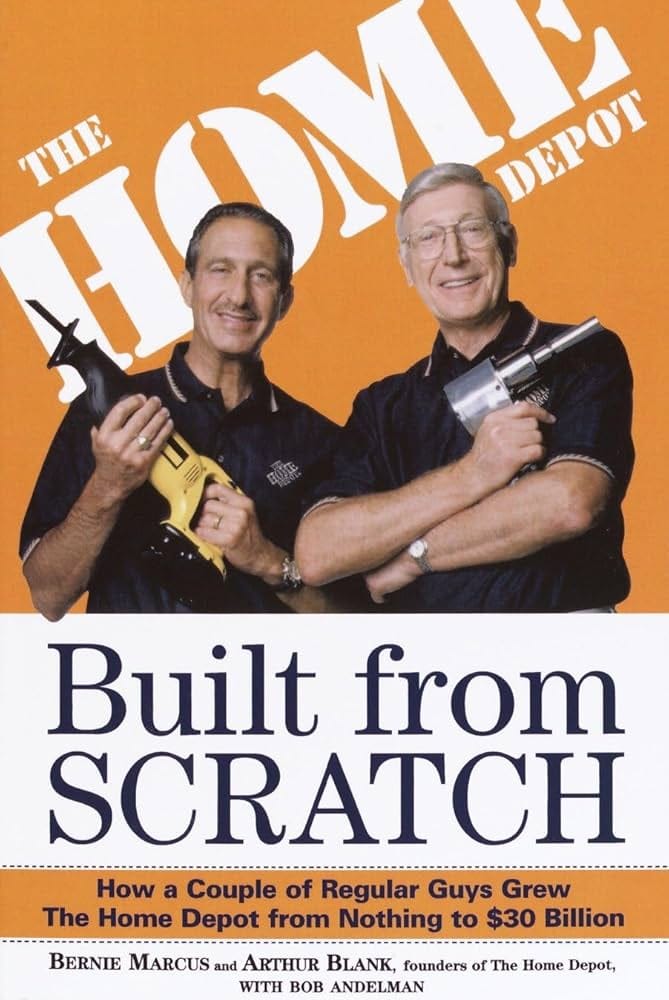
I've been spending time with Built From Scratch by Bernie Marcus and Arthur Blank. Not because Home Depot is trendy or because retail is glamorous, but because it's one of the cleanest examples of what actually holds up when a founder-led business gets big and what breaks when it doesn't.
Marcus and Blank weren't seasoned retail titans when they started. They were fired executives with something to prove. What they built wasn't just a fast-growing company. It was a business that could keep growing without them being involved in everything.
That distinction matters if you ever want real exit options.
Best Links
💰Sales: If you’re focused on scale and you still carry a lot of operational responsibility, a good place to start is your coaching and development infrastructure. This article on keys to effective sales coaching has practical techniques for building repeatable execution into your teams 👉 Link
🌟 Industry Trends: Dr. Peter Attia talks on how the last meaningful 10 years of life (what Attia calls the marginal decade) actually determines quality of life long before death. 👉 Link
🍏 Extra Credit:
We’re no longer in a world where just “doing what worked before” gets you deep penetration or predictable outcomes.
First principles thinking helps you:
• Build systems that are robust
• Spot true levers of value before competitors do
• Avoid incremental copycat strategies that look okay but fail under scrutiny
That’s exactly the difference between companies that scale and companies that exit well. 👉 Link
Here are the lessons that still matter for founders scaling today…
They removed themselves as the decision bottleneck early
From the beginning, Home Depot pushed authority down to store managers. Pricing decisions, staffing choices, customer issues were all handled locally, not escalated to headquarters.
This felt risky. It meant inconsistent decisions and mistakes in the short term. But it solved a bigger problem: the founders didn't become the system.
Most founders delay this handoff until they're exhausted. By then, the business has already learned to depend on them. Home Depot flipped that order.
They treated product knowledge as infrastructure
Employees were expected to actually understand what they sold. Not at a surface level, but well enough to help customers solve real problems.
This required investment. Time, patience, repetition. But it paid off in ways that don't show up immediately: fewer returns, higher customer trust, better word-of-mouth, and employees who could make decisions without supervision.
When knowledge lives in the organization rather than just in the founder, the business becomes steadier and easier to transfer.
They optimized for execution, not cleverness
Home Depot didn't win because of sophisticated strategy. It won because stores were clean, shelves were stocked, and customers could get help.
That sounds obvious. It's also where many scaling companies fall apart. As businesses grow, founders often chase new initiatives instead of tightening execution. Complexity creeps in. Standards slip.
Home Depot stayed boring on purpose. That boredom is what buyers trust.
They built culture intentionally
Culture wasn't something Home Depot hoped would carry through. They hired for values, promoted from within, and reinforced expectations constantly.
This mattered because founders eventually step back, whether intentionally or not. If culture isn't designed, it evaporates the moment the founder isn't in the room. Buyers can spot this immediately during diligence.
They expanded only when systems could support growth
Home Depot grew fast, but not recklessly. New stores opened when supply chains, training programs, and management layers were ready. Growth followed operational readiness, not ego or pressure.
Many founder-led businesses do the opposite. They grow first and fix later. That creates margin compression, burnout, and operational debt, all of which hurt valuation.
Trust replaced control as the company grew
Rather than adding layers of approval, they trusted people to make reasonable decisions. This didn't eliminate mistakes. It reduced dependency.
When founders rely on control, everything requires their involvement. When they rely on trust, systems mature. Trust is uncomfortable. It's also what allows scale to survive founder absence.
They built systems that worked without heros
Home Depot wasn't dependent on exceptional individuals saving the day. Processes were clear. Expectations were consistent. Work didn't require constant intervention.
Heros feel good early on. They're poison later. Buyers look for businesses where performance is normal, not the exception.
The real test
Marcus and Blank didn't frame this as exit planning. But functionally, that's what they did. By distributing authority, knowledge, and standards, Home Depot became a business someone else could own, operate, and grow.
Where to look in your business
If you're scaling with an eventual exit in mind, ask yourself:
Where are decisions still defaulting to you?
Where does knowledge live only in your head?
Which parts of the business slow down when you step away?
Are systems strong enough to carry standards w/o constant enforcement?
Is growth happening faster than operational readiness?
Before You Go
A “yes” isn’t failure. It’s a signal. Home Depot didn't remove the founders overnight. They designed the business so it didn't need them forever.
That's the work.
-Kinza
 |
Reply