- The Sideline
- Posts
- 🏈 10 hard lessons from a $66M exit
🏈 10 hard lessons from a $66M exit
(she didn't plan to share these)

Kinza Azmat
April 14, 2026
🏈 THE SIDELINE
You'll learn: How Barbara Corcoran built and sold a $66M real estate empire + 10 moves she made that aren’t polished enough for business books to admit.
Read time: 5 minutes
Real deal analyzed: The Corcoran Group: $1,000 start, $66M exit, 28 years of getting underestimated

🌎 Expand Your Thinking
An investor asked me this week, “are businesses shutting down because of AI?” I’m bullish on small business’ resistance to AI for two reasons
small businesses are providing physical services
92% of small businesses are using AI, it’s just a matter of catching up
This graphic measures the win % that the top evaluated model had against human experts as benchmarked through GDPval. Based on that, it is clear that the models have gotten significantly better at economically valuable work since fall 2025.
If you’re a small business owner, find your industry below. Did you notice an improvement in how AI helps in your industry? If not, you’re falling behind (link)

SBA Ray on the default rate 100 bips above adjusted 30Y average…4.5%. That said, I bet the default rate in new business acquisition loans is far higher. Wish the data was segmented better. (link)

How to ship a great MVP (link)

If you’re building a new company, product, service…keep going (link)

What investors are pouring money into right now (link). Is your business in one of these industries? Watch out for tech disruption.

10 Things She Actually Did
Here's how Barbara Corcoran's billion-dollar business started:
She borrowed $1,000 from her boyfriend in exchange for 51% of the company.
Then he left her for her secretary.
Told her on his way out, "You'll never succeed without me."
She went on to build The Corcoran Group into the most dominant real estate firm in New York City and sold it for $66 million.
But here's the thing about her book, Shark Tales…it doesn't read like a victory lap.
It reads like the unfiltered truth of what actually happened between the $1,000 and the $66M. The mistakes, near-bankruptcies, and moments where she had no idea what she was doing…and did it anyway.
Keep reading to see what stood out.
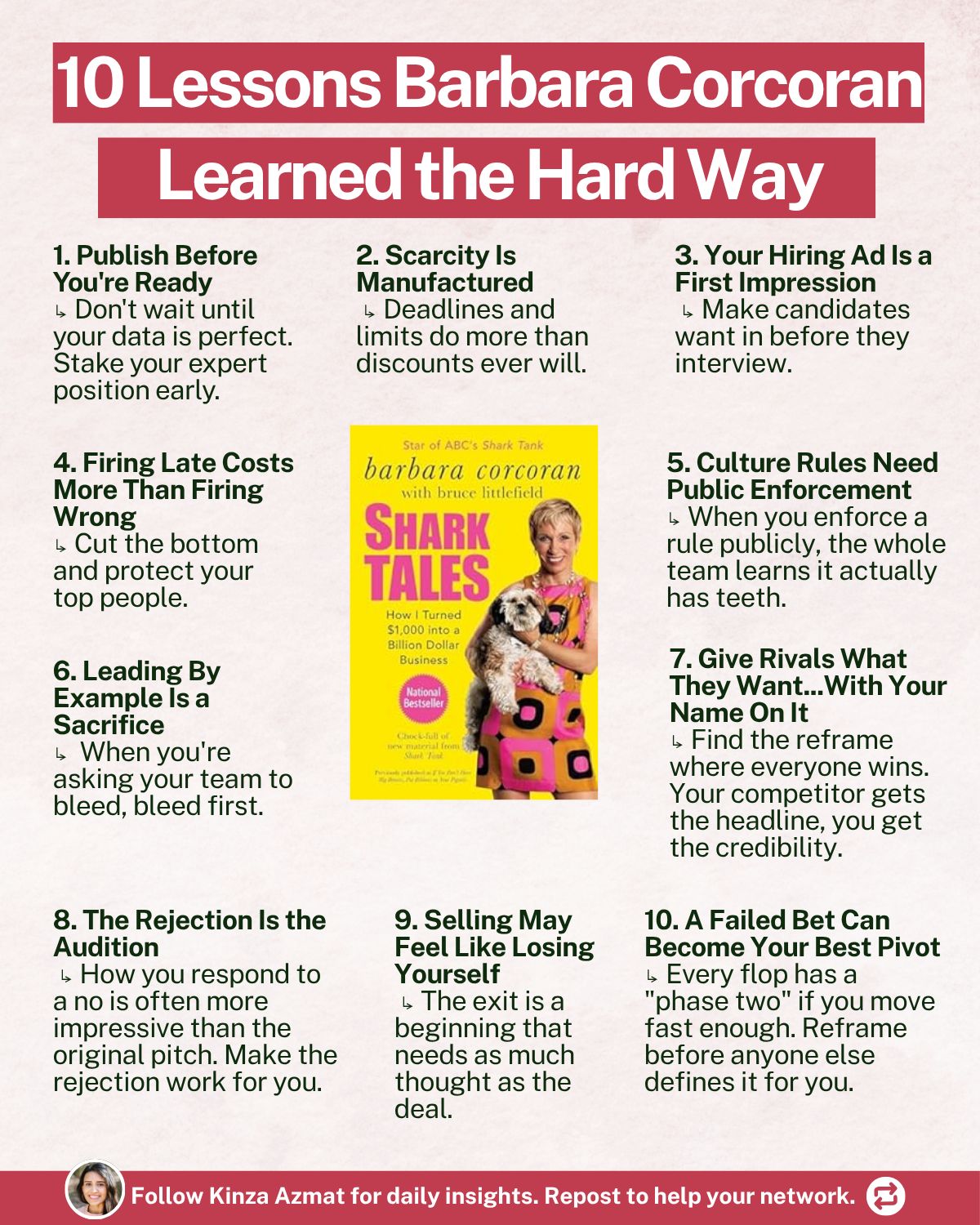
She published before she had enough data. Her first "market report" was based on 11 of her own apartment sales. She called it the NYC Apartment Price Report, mailed it to every journalist at the New York Times (including the sportswriters). It landed on the front page! The lesson isn't about luck. It's that staking your expert position early, beats waiting until you feel ready.
She manufactured scarcity from nothing. 88 apartments went unsold for three years, considered the dregs of the market. She priced them all identically, refused to release the addresses until the morning of the sale, whispered to her team that there "might not be enough to go around," and sold every single one in ONE morning with buyers lined up around the block from 4am. She didn't discount…she engineered urgency. Deadlines and competition will always outperform price cuts.
She made candidates compete to get in. When she needed to hire, she ran an ad for "ONE empty desk." When people called, she told them the position was already filled, then offered to meet anyway so she'd have them on file. Every candidate arrived already wanting in, already grateful for the meeting. Scarcity attracts people who actually want to earn it.
She cut the bottom every year without apology. Her top 10% of salespeople made 80% of the revenue. She made it a standing policy to cut the bottom 25% annually (just like BCG and GE ha!). How she thought about it is the takeaway: $40,000 overhead per desk, someone making $20K in commissions wasn't a safe bet, they were a $20,000 loss. An underperformer isn't better than an empty desk…they're a drain on the people who are actually performing.
She enforced culture publicly, not privately. Her best lister was secretly hoarding over 30 listings in her desk drawer, keeping them from colleagues, pocket-listing them for her own customers. Barbara waited until the Monday morning meeting, walked to her desk in front of the entire office, opened the drawer, read each address out loud, and dealt the listings out to other agents like a deck of cards. "Pack your things." This one is giving public shame vibes, Brene Brown is prob going to hate this lesson: Quiet correction protects feelings…public correction teaches that rules actually have teeth.
She bled first. When the company was $264K in the hole with its credit line pulled, she didn't give a speech about resilience. She took a second job at a competing developer for $200K/yr and fed her entire salary back into The Corcoran Group. She didn't announce it as noble sacrifice. But her team noticed anyway and rallied around her. You can’t ask people to bleed for a business you aren't willing to bleed for yourself.
She turned rivals into billboards. Trump called her furious that The Corcoran Report ranked Trump Tower 4th on a list of Manhattan condos. Most brokers would have apologized and caved. She walked around to Trump’s side of the desk, put her arm on his shoulder, and said "what if we measured price per square foot instead of total sale price?" It legitimately put him first. He took out a full-page Wall Street Journal ad citing The Corcoran Report as the source. She gave him the headline. She got the credibility. Find the reframe where everyone wins.
She turned the rejection into the audition. When Shark Tank's producers chose another woman for the female Shark seat, Barbara wrote a detailed email directly to Mark Burnett making the case for why having both of them would make better television. She had it hand-delivered in addition to emailed. Then she booked her flight to LA anyway. The confidence, specificity, and sheer nerve of that email was a better demonstration of her personality than any audition tape. How you respond to a no is often the real pitch.
She wasn't ready for the exit…and says so plainly. She sold for $66 million and was, in her own words, secretly miserable. Didn't know what to wear in the morning. Felt like an impostor. Found that money brought an entirely new set of problems she hadn't anticipated. She writes with striking honesty that she'd always felt more at home with cabdrivers and doormen than with fancy people (!) and that suddenly having a lot of money made her feel guarded, second-guessing everyone's motives. The exit is not a finish line. It's a beginning that needs as much planning as the deal itself.
She reframed the failure before anyone else could. She spent $71,000 producing listing videos that nobody watched. They sat molding in a flooded basement. The following week her husband came home raving about something called the internet. She put the same content online, becoming one of the first real estate firms in America to list properties on the web. At the next company-wide sales meeting she stood up and announced "phase two of our Homes on Tape project." The belly-flop became the story of a visionary bet on the future. Every failure has a phase two if you move fast enough to write that chapter yourself.
What to do with this information?
The through-line across all 10 lessons is deceptively simple: act before you feel ready, then control the narrative of what happens next.
Barbara didn't have enough data, she published anyway.
She didn't have the money to survive, she took a second job.
She didn't get the Shark Tank seat, she wrote the email anyway.
She didn't have a good story about the flooded basement, so she wrote one.
Most of what separates business owners who build something real from those who stay stuck isn't intelligence or resources.
It's the willingness to move on incomplete information and then own whatever comes next, loudly, confidently, before someone else defines it for you.
Three questions worth sitting with this week:
Where are you waiting to feel ready?
Who’s on your team just because you’re being nice?
What's your "phase two" story for something that hasn't worked yet?
Chat next week,
Kinza

Reply